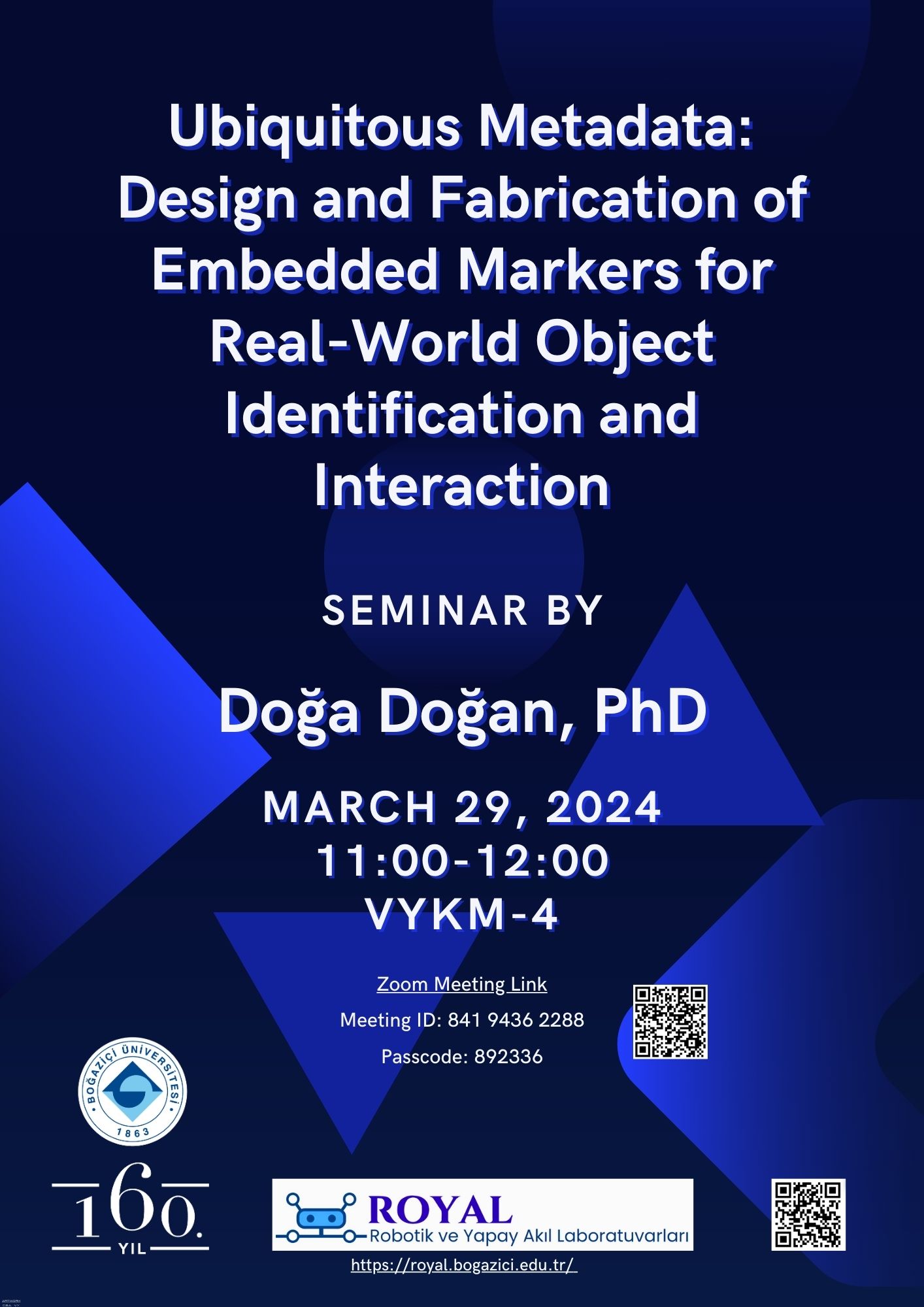
Ubiquitous Metadata: Design and Fabrication of Embedded Markers for Real-World Object Identification and Interaction
Speaker: Doğa Doğan, PhD
Location: Engineering Building, VYKM 4
Short CV: Doğa Doğan is a recent Ph.D. graduate of the MIT Computer Science and Artificial Intelligence Laboratory (CSAIL), where he worked with Prof. Stefanie Mueller as part of the HCI Engineering Group. Doğa’s research focuses on the fabrication and detection of machine-readable tags embedded into everyday objects, products, and materials. His work has been nominated for best paper and demo awards at CHI, UIST, and ICRA. He is a past recipient of the Adobe Research Fellowship and Siebel Scholarship. In the past, Doğa worked at Google, Adobe Research, TU Delft, UCLA Laboratory for Embedded Machines and Ubiquitous Robots, and Max Planck Institute for Intelligent Systems. His website: https://www.dogadogan.com/
Abstract: The convergence of the physical and digital realms has ushered in a new era of immersive experiences and seamless interactions. As the boundaries between the real world and virtual environments blur and result in a "mixed reality" (MR), there arises a need for robust and efficient methods to connect physical objects with their virtual counterparts. In this talk, I will present a novel approach to bridging this gap through the design, fabrication, and detection of embedded machine-readable markers. The realization of MR hinges on the awareness of mobile and wearable devices about the surroundings to enhance real-world experiences with contextual information. Traditional machine-readable tags, such as barcodes and RFID labels, commonly employed for object identification, exhibit drawbacks like obtrusiveness and reduced durability or security. Typically added post-fabrication, these tags lack compact integration into the original object design. In response, my research introduces innovative tagging approaches that extract hidden, integrated features of objects and employ them as machine-detectable markers. We categorize the proposed marking approaches into three distinct categories: natural markers, structural markers, and internal markers. Natural markers, such as those used in SensiCut, are inherent fingerprints of objects repurposed as machine-readable identifiers, while structural markers, such as StructCode and G-ID, leverage the structural artifacts in objects that emerge during the fabrication process itself. Internal markers, such as InfraredTag and BrightMarker, are embedded inside fabricated objects using specialized materials. Leveraging a combination of methods from computer vision, machine learning, computational imaging, and material science, the presented approaches offer versatile solutions for object identification, tracking, and interaction. These markers, seamlessly integrated into real-world objects, effectively communicate an object’s identity, origin, function, and interaction, functioning as gateways to "ubiquitous metadata" – a concept where metadata is embedded into physical objects, similar to metadata in digital files. In the talk, I will demonstrate the applications of the presented methods in diverse domains, including product design, manufacturing, retail, logistics, education, entertainment, security, and sustainability. Join me in envisioning a future where objects come alive, environments are interactive, and virtual worlds seamlessly merge with our everyday lives.
Seminar can be accessible via following Zoom link and the info stated below:
Seminar link: https://us06web.zoom.us/j/84194362288?pwd=UkeXht4pGUKRMlyYb2THpAADCpFCR1.1
Meeting ID: 841 9436 2288
Passcode: 892336